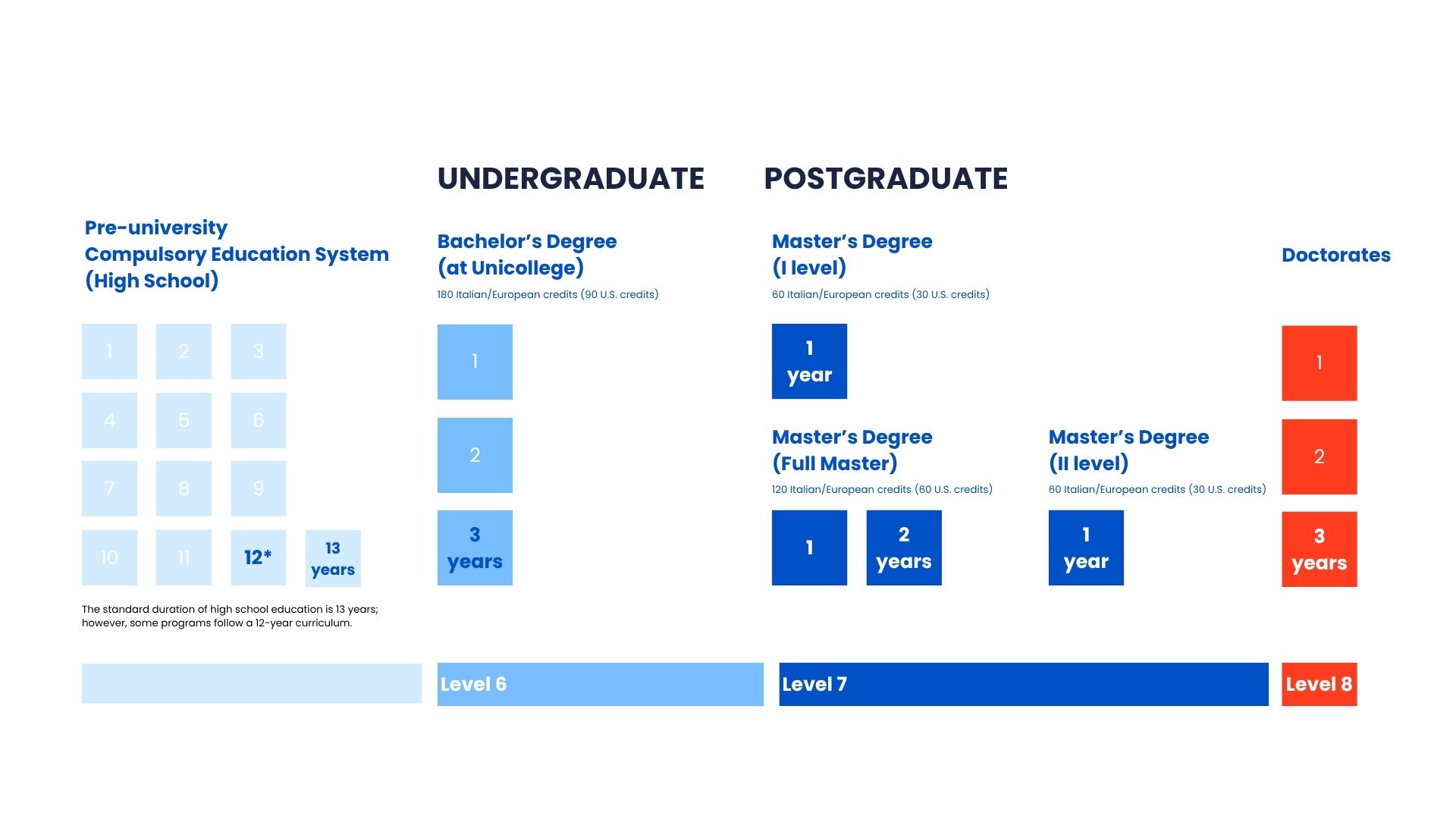
| Italian university system | US university system | |
| Official denomination | Laurea Triennale (Lit. Three-Year Bachelor’s Degree) |
Bachelor’s Degree |
| Duration | 3 years
Some degree programs follow an integrated Bachelor’s + Master’s structure and have a total duration of five or six years (such as medicine, architecture, or engineering). These programs are single-cycle degrees and cannot be divided into separate Bachelor’s and Master’s qualifications. Students must complete the full program in order to be awarded the final degree. |
4 years |
| Credits | 180 Italian/European credits (90 US credits)
Note: While the total number of credits differs between Italy and the United States (90 vs. 120 U.S. credits), Italian students complete an additional year of high school that is commonly recognized as equivalent to the first year of U.S. university general education. The two degrees are therefore considered internationally equivalent. |
120 US credits |
| Progression | Eligibility to MA programs | Eligibility to MA programs |
| Italian university system | US university system | |
| Official denomination | Laurea Magistrale (Full Master)
Or Master’s Degree (I level) Or Master’s Degree (II level) In the Italian higher education system, there are three main types of Master’s programs. |
Master’s Degree |
| Duration | Laurea Magistrale (Full Master’s Degree) (2 years)Master’s Degree (I level) (1 year) Master’s Degree (II level) |
1 or 2 years |
| Credits | Laurea Magistrale (Full Master’s Degree) (120 Italian/European credits – 60 US credits)Master’s Degree (I level) (60 Italian/European credits – 30 US credits) Master’s Degree (II level) |
30 and up to 60 US credits |
| Progression | Eligibility to PhD programs | Eligibility to PhD programs |
| Italian university system | US university system | |
| Official denomination | Dottorato di ricerca | Doctorate or Philosophy Doctor |
| Duration | 3 years | 3 to 8 years |
| Credits | This program does not bear academic credits and is project-based – with minor taught components and a thesis-based project. | 48 and up to 120 |
| Progression | Eligibility to post-Doc programs | Eligibility to post-Doc programs |
In the Italian higher education system, exams recorded in a student’s official transcript are graded on a 30-point scale, ranging from 18/30 (minimum pass) to 30/30 (highest mark). Outstanding performance may be awarded 30/30 e lode (distinction). Exams graded below 18/30 are considered not passed and are therefore not recorded on the official academic transcript.
The final degree grade (graduation mark) is awarded on a 110-point scale, with scores ranging from 66/110 (minimum pass) to 110/110 (highest mark). Exceptional academic achievement may be recognized with 110/110 e lode (distinction).
The Italian/European Credit Transfer and Accumulation System (ECTS) is used to quantify the total academic workload required to complete a course or program. Workload includes lectures, seminars, practical activities, fieldwork, individual study, and examinations or other forms of assessment.
Degree programs are typically structured around a workload of 60 Italian/European per academic year (30 U.S. credit equivalent)..
- 1 Italian/European credit = approximately 25 hours of total student workload
- 1 Italian/European credit = 0.5 U.S. semester credits
At Unicollege, courses typically have a contact duration of 36 hours. Instructional time is calculated using full 60-minute hours. When expressed in academic-hour format (where 1 academic hour = 50 minutes), this corresponds to approximately 43.5 academic hours.
Based on contact hours and total workload, each individual Unicollege course is fully aligned with a standard U.S. university course, corresponding to:
- 45 academic hours (50-minute hours)
- 3 U.S. semester credits
This structure ensures full compatibility between Unicollege courses and standard undergraduate or graduate courses offered by accredited U.S. universities, supporting credit recognition and transfer within U.S. academic frameworks.